Most organisations we meet have plenty of AI and very little agreement about how it should work. Every team, and often every tool, has its own way of doing things. So we wrote ours down. This is the operating system we run AI Accelerator on, and you can explore it for yourself.
Read the transcript
So how do you get AI to work the way that your business does? This is how we do it.
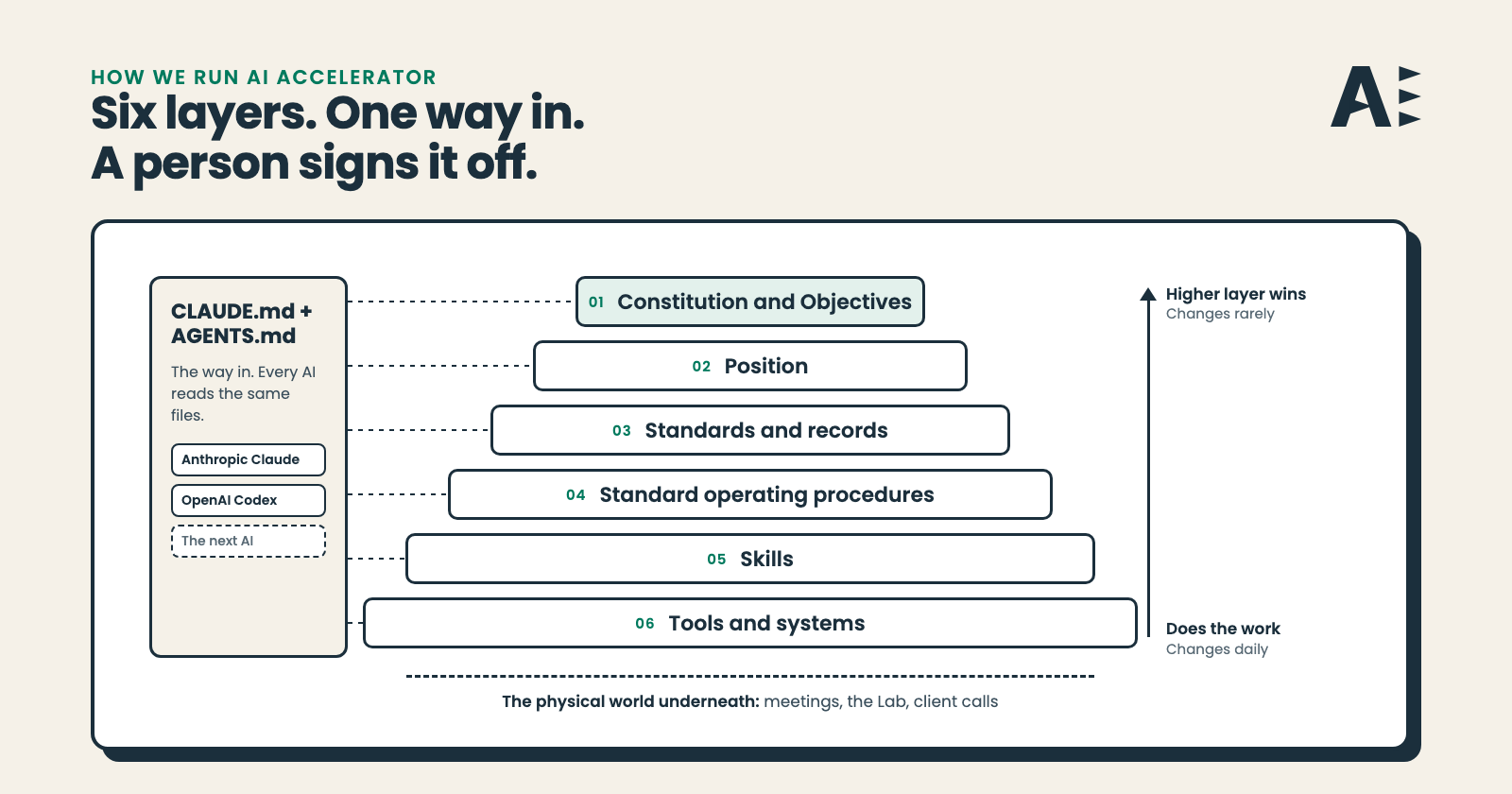
Six layers, rules at the top, tools at the bottom. The higher layer always wins. The top rarely changes. The bottom changes daily.
Every AI comes in through the same door. Today, that's Anthropic's Claude and OpenAI's Codex. The next might be Cowork, or it could be Grokbot or Muse. The next AI plugs in and knows how we work.
So who signs off AI work? Well, the task runs down the stack, collecting what it needs. Agents split it up and work in parallel. A person checks it and signs it off.
Security runs through every layer. Personal data never goes into a consumer AI tool. It stops at the edge.
Then loops. Every week, lessons from finished work feed back into the skills, procedures and standards. After every task, an improvement loop helps to make things better. And every meeting becomes actions, decisions and logs that form our organisational memory.
Have a play around with it at aiaccelerator.uk/operating-system. We're building the future. How are you building it?
Open the interactive to turn it, open each layer and follow a task through it.
01What we mean by an operating system
For us, an operating system is two things. The first is the written rules that tell people and artificial intelligence (AI) how we work. The second is the wiring that makes every AI follow them. It isn't a tool. Tools change every few months. The rules underneath are what make each new tool useful, because it starts from the same place as the last one.
It sits in six layers, from the rules that change least to the work that changes daily. When two rules disagree, the higher layer wins.
02Six layers, and the higher one wins
- The Constitution and Objectives. Eight articles and twelve operating principles that bind people and AI alike. A person is always accountable.
- Position. What we are, who we serve, how we reach them and how we sound.
- Standards and records. How we do each thing, from proposals to security, and one index that names a single home for every kind of information.
- Standard operating procedures (SOPs). The repeatable jobs, step by step, each owned by a person, with the human judgement kept in.
- Skills. A shared library that carries out the steps an SOP hands to AI.
- Tools and systems. Where the work lives: tasks, relationships, files and conversations. Swap a tool and the layers above stay the same.
Underneath all of it is the physical world: our standing meetings, workshops at the AI Adoption Lab in Greenwich and calls with clients.
03One way in for every AI
Every AI that works for us reads the same instruction files: a CLAUDE.md and an AGENTS.md side by side, at every level from the company down to a single project folder. Each one points back to the Constitution and never restates it.
Today that means Anthropic's Claude and OpenAI's Codex. When the next AI comes along, it doesn't need a second set of rules. It's cleared first, with a data processing agreement in place and no training on our data. Then it reads the same files and knows how we work.
04Who signs off AI work?
Take a single task. It's picked up with a named owner, and on its way down the layers it collects what it needs: the limits from the Constitution, who it's for from our Position, what good looks like from the standards, the steps from the procedure and the method from a skill.
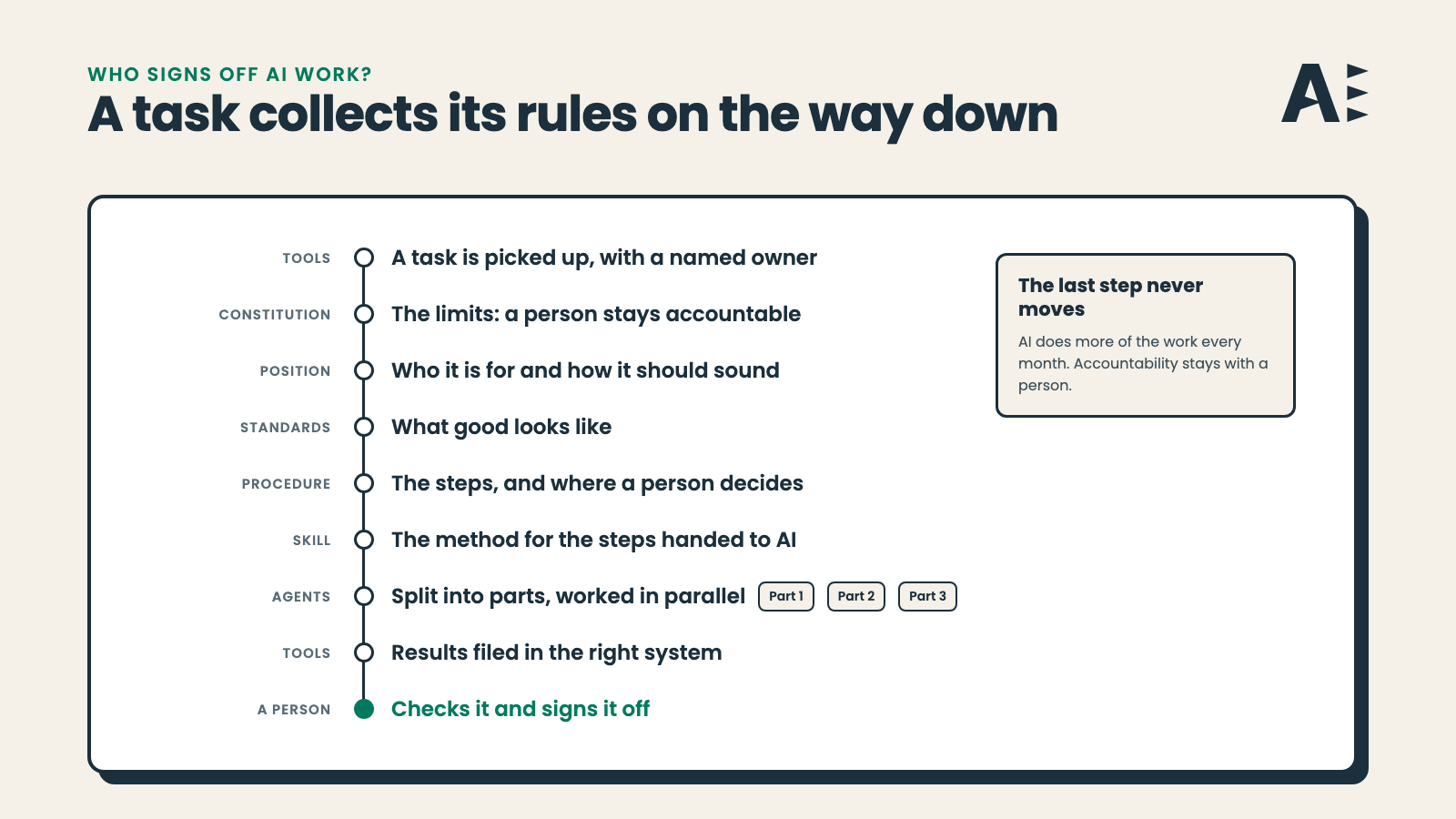
Then agents split it into parts and work on them in parallel. The results are filed in the right system, and a person checks the work and signs it off. That last step never moves. AI does more of the work every month, and accountability stays with a person.
05Security runs through all of it
Security isn't a separate project bolted on at the end. Every layer carries its own rules and checks, so they move with the work. Personal data stays in approved company systems. It only goes into an AI with a data agreement in place and training switched off, and it never goes into a consumer AI tool. If something slips, it's reported straight away.
06It gets better every week
Two loops keep the system learning. When a piece of work closes, its lessons are captured, and each week they're promoted into a skill, a procedure, a standard or an instruction file. And every meeting becomes a transcript, then actions and decisions, then work. Nothing depends on someone's memory.
It isn't finished, and it won't be. Some of our standards are still drafts, and we change the system as we learn. That's the point of writing it down: you can see what's there, and you can improve it.
07What this means for you
We built this for ourselves first. As an AI capability partner, we want to work the way we help clients work. When we build it with your team, you get the same shape: your rules written once, one way in for whichever AI you use, procedures that say where a person decides, and loops that keep it all current. Your people keep the judgement. The AI does more of the legwork.
Explore the interactive to follow a task through it, or talk to us about building yours.