AI on the claims floor, not just in the pilot.
We help insurers get from scattered AI pilots to everyday use. Leaders agree where the line is, underwriters and claims teams learn on their own kind of work, and every use case clears compliance before it scales.
Already running an AI programme? See how we fit in ↓︎
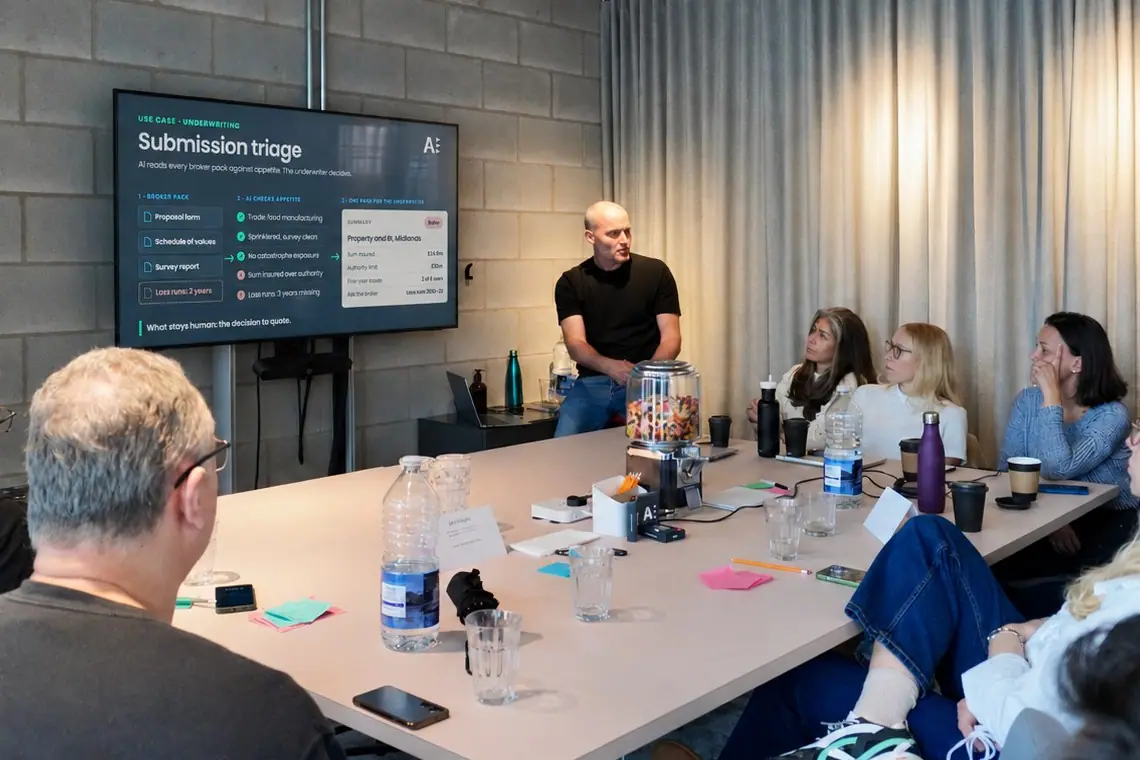
Where this comes from
- An international insurance groupAI adoption work across several of its businesses in 2025 and 2026
- 200+ senior leadersDirectors, VPs and executives, in live sessions
- 40+ live sessionsLeadership briefings, workshops and webinars
- Cyber Essentials PlusCertified, and registered with the ICO
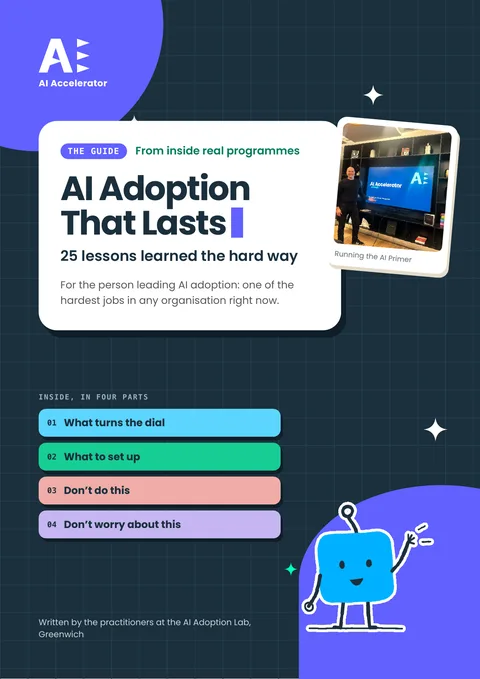 Free guideAI Adoption That Lasts: 25 lessons from running AI adoption programmes.Read it now →︎
Twice as many people using AI every day.
An insurer surveyed its own people after a series of our live AI sessions. Here is what they reported.
Daily AI use, before and after
19% →︎ 41%
use AI at work every day. Each figure is about 5% of the people surveyed.
Never used AI at work
1 in 7 →︎ none
before and after the sessions
68%
say their written communication improved
59%
say they turn work around faster
Average rating
4.4 / 5
for the series
Self-reported by participants in the insurer's own survey.
What we see in insurance.
Most insurers already have AI licences and a few keen early users. The blockers sit elsewhere.
A few enthusiasts get value. The underwriting and claims floors work the same way they did last year.
Nobody has said what can go into which tool, so people either avoid AI or use it quietly.
Customer data, call recordings and meeting transcripts raise GDPR questions before anyone starts.
Consumer Duty, the EU AI Act and US state guidance all ask how AI decisions are made and checked.
Your programme first. Then where we fit.
Your AI programme has its own goals and its own shape. So we start by understanding it: what it needs to achieve, how it's structured and where you want to accelerate. Then we add only what helps.
Leadership sessions
Your senior team uses AI on its own work and sees what other leaders are trying.
Practitioner-led training
Underwriting, claims and distribution teams learn on their own kind of work.
Practitioner webinars
Regular live sessions open to the whole business: we show how, then everyone has a go.
Ongoing platform access
Short lessons, insurance use cases and reusable skills between sessions.
40 ways insurers are putting AI to work.
The same cards our platform uses. Scroll through them, or pick a team, and open one to see what AI does and what stays with your people.
Why now: skills
Agents used to be projects for IT. Skills put the same power in everyone's hands. A skill packages how your best people do a task, the steps, the checks and the house style, so anyone in the team can run it with AI and get the same quality. Many of these use cases start life as a skill.
The underwriter decides what to quote and on what terms.
The underwriter judges what the trend means for the risk.
Wording sign-off stays with the underwriter and legal.
The underwriter weighs the precedent.
The underwriter judges what the findings mean for the risk.
Managers decide what to follow up, with whom, and any coaching.
The underwriter or handler approves what goes out.
The underwriter decides whether outstanding items change the terms.
The underwriter confirms the record says what they meant.
Underwriters set the limits and handle every referral.
The handler checks it and owns the file.
The handler confirms the note is right.
A recovery specialist decides what to pursue.
The handler, and coverage counsel where needed, decide the position.
The handler talks to the customer and decides what support to offer.
Handlers set the limits and take every exception and complaint.
The relationship stays with you.
Compliance signs off the final text.
The underwriter sets the terms and the broker advises the client.
The account executive checks every fact before it goes to market.
The broker recommends and the client chooses.
The broker advises; the client decides what to buy.
The account executive decides whether to call the client.
A person answers anything uncertain and makes every claim decision.
Risk engineers set the advice; customers decide what to do.
Underwriters answer anything outside the written appetite.
An actuary validates the explanation before anything changes.
Pricing and conduct teams approve the change.
Actuaries sign off the rebuild against the original results.
The analyst decides what to fix and what to exclude.
The DA team resolves the exceptions.
The DA manager decides the response.
The customer outcomes team decides on fixes.
Product governance and the board reach the conclusions.
Finance signs off the close.
Leaders choose what to change.
A person checks the exceptions it could not match.
Data owners approve how closely it mirrors reality.
System owners and actuaries confirm the rules are right.
The migration team decides each fix.

We show you what your competition could launch next.
We challenge leadership teams by building what a competitor could put in front of your customers, so you can see how easy it now is and how quickly you need to move. A well-tuned AI harness can do this for you. It can do it for them too.
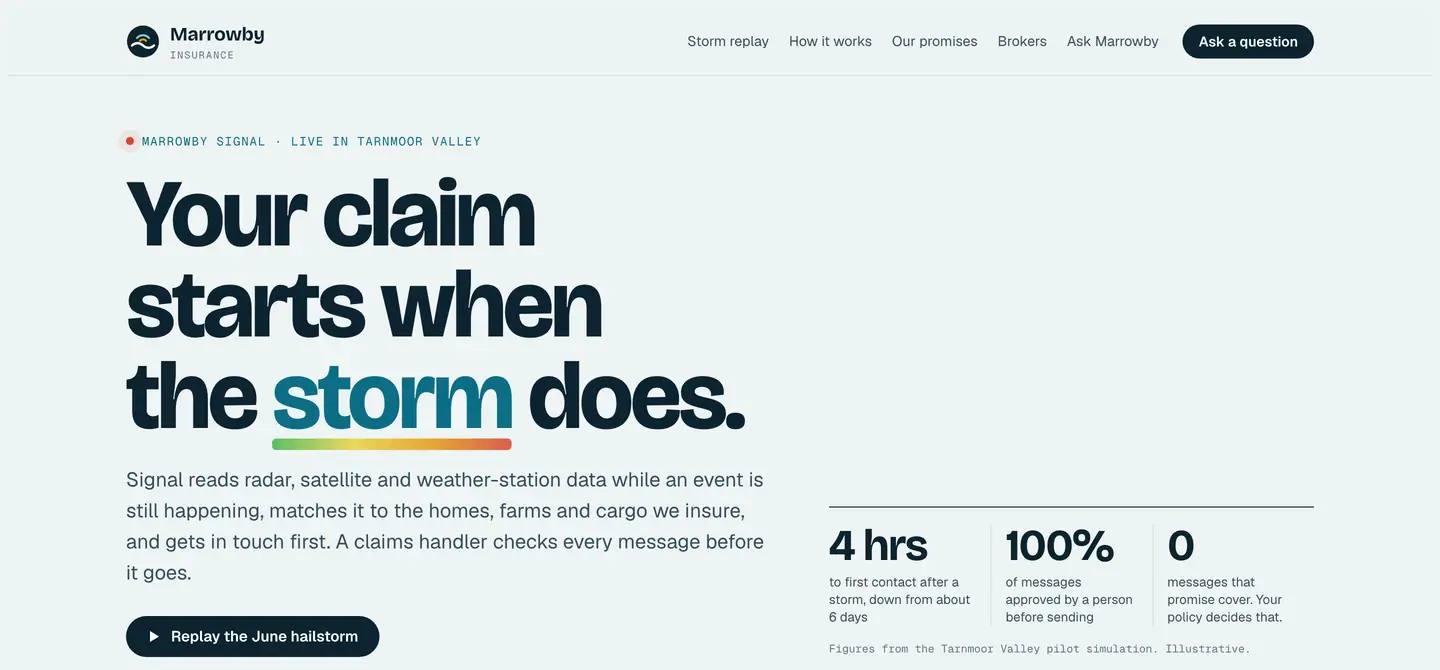
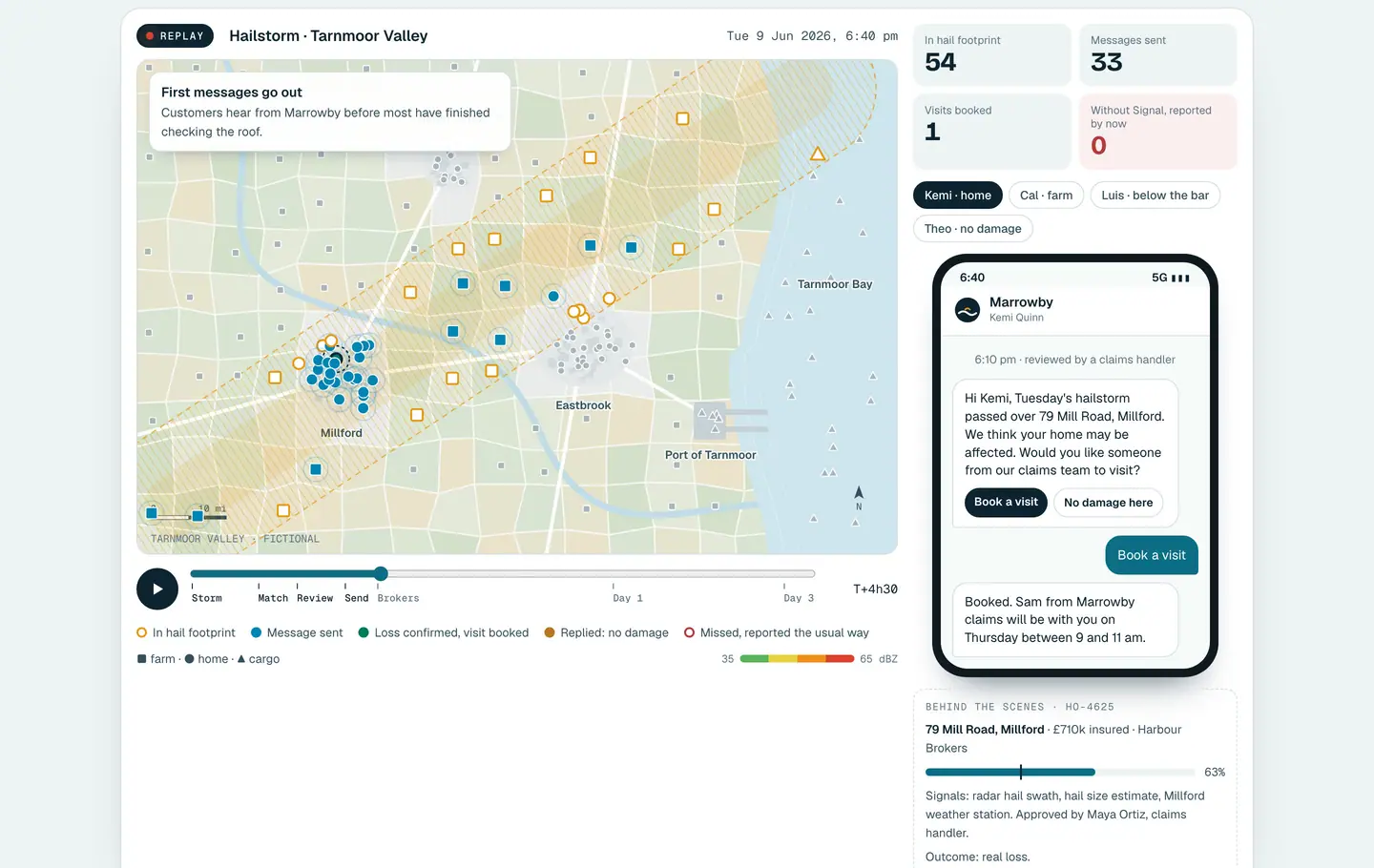
Marrowby is an insurer we invented. Its storm-claims service, its website and its film were all built with a well-tuned AI harness, in days rather than months.
We don't hand you an answer. We show your people what AI can do.
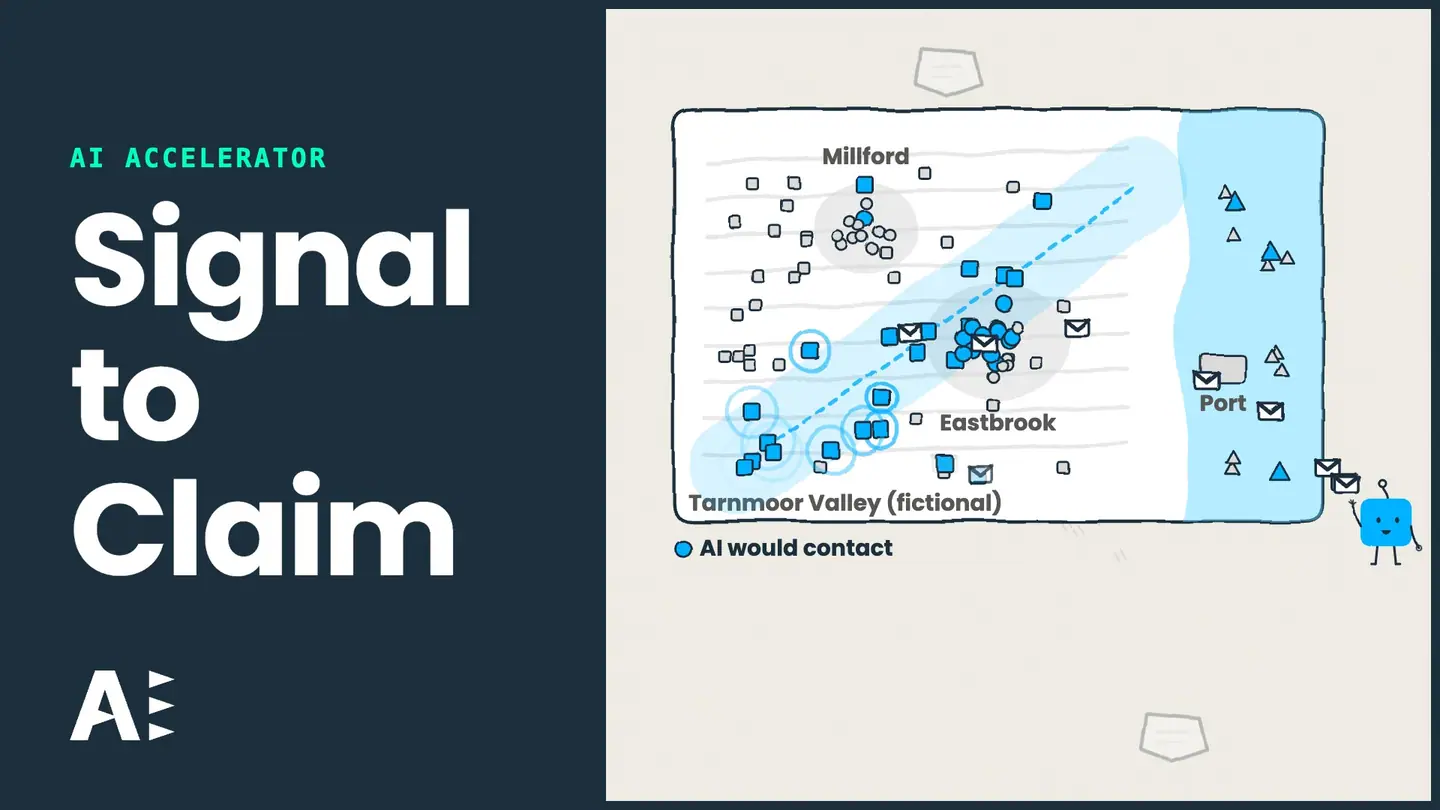
Signal to claim · 1:18 · a fictional insurer, Marrowby
This is the kind of film we make, here explaining the Marrowby service.
The point isn't the product. It is to show your leaders and teams what is now possible, so they can see how AI could change their own work and use it better.
- Built with AI, checked by people. Every message in the film passes a claims handler first.
- Made for your sessions. We build examples like this around the problems your teams raise.
The questions your compliance team asks first.
What can go into which tool?
We help you write simple rules by data type and tool, so staff know what they can paste in and why.
Recordings and transcripts
Calls and meetings hold personal data by default. We show teams how to mask it before transcripts reach other AI tools.
New uses and DPIAs
Each new use gets a short assessment your DPO can sign off, drafted with AI and checked by people.
Keeping up with regulators
FCA Consumer Duty, PRA expectations, the EU AI Act and US state guidance, mapped to the uses you actually run.
We work this through with your compliance and legal teams. It is not legal advice.
AI changes every month. Your people's knowledge should too.
A one-off course goes stale. Our platform keeps a steady supply of short lessons, use cases and activities coming to your teams, updated as the tools change. Signal, our newsletter, tells your leaders what changed and what it means for them.
- Minutes, not days. Each card is a short lesson, a use case or an activity people can do in their working week.
- Your own use cases. The use cases your teams choose sit beside ours, on the same cards.
- Signal. What changed in AI, and what it means for insurers, in plain English.
- Measurement built in. It is why we built the platform. You see who is using AI, which use cases stick and how confidence changes from people's first check-in to their last, so you can show the board what changed.
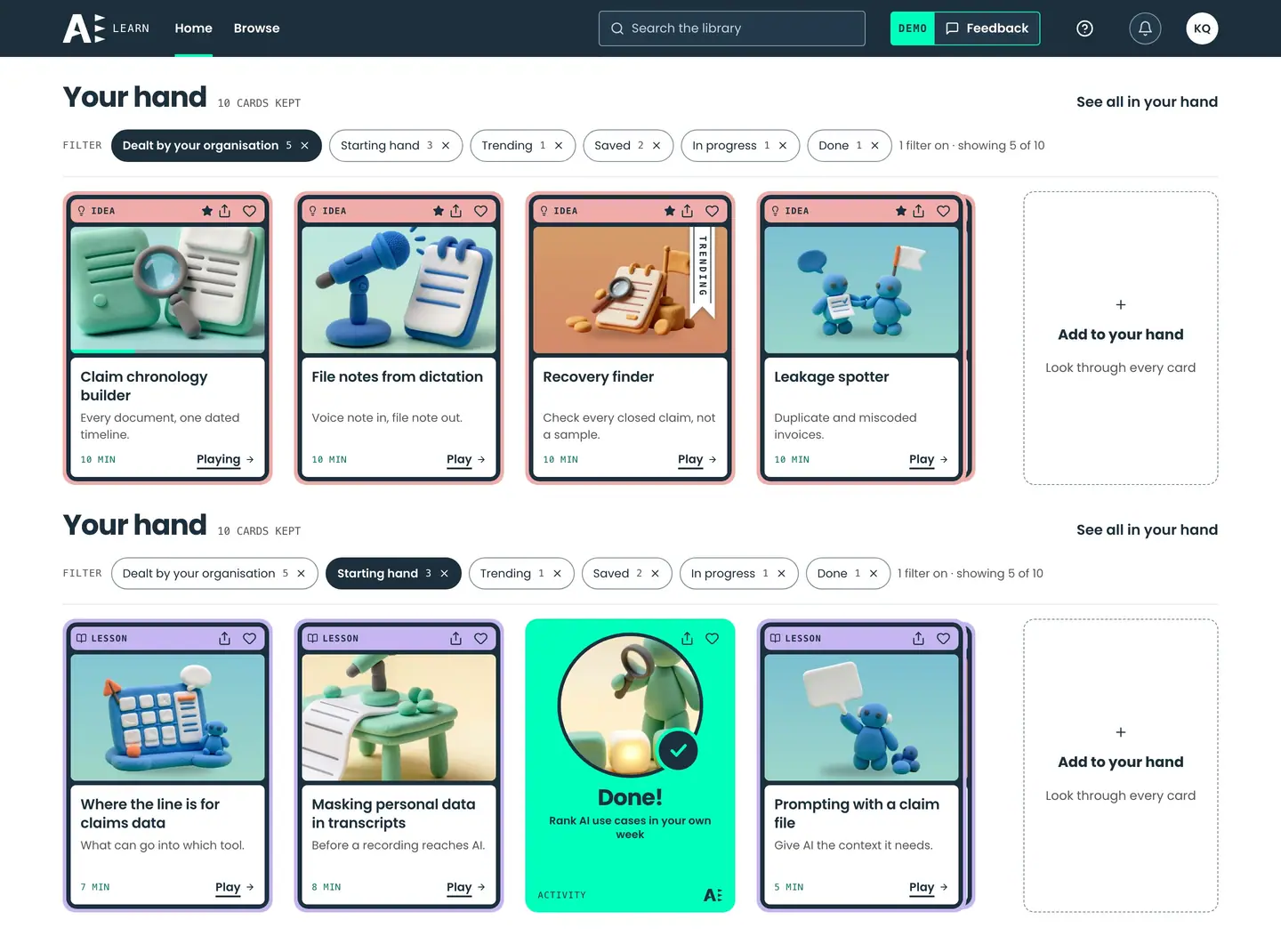
- Dealt by your organisation. Your AI lead deals insurance use cases to each team.
- Trending. Teams see what colleagues elsewhere in the business are trying.
- Your own rules. Lessons written to your policy, such as where the line is for claims data.
- Progress you can see. Done cards show who has picked up which habit.
- Ten minutes a card. Short enough to fit inside the working week.
Working with us, step by step.
Start wherever suits you. Each step is useful on its own, and you decide whether to take the next one.
Step 1 · 30 minutes · Free
Compare notes with us
We share what is working across insurance and ask about your teams. You leave with three use cases worth trying first.
You do: pick a time. We do: send two short questions beforehand.
Book a time →︎Step 2 · Half a day
Brief your leadership team
Your senior team uses AI on its own work, agrees where the line is and picks the first use cases. Online, at your office or at our Lab in Greenwich.
You get: a short written plan your board can read.
About leadership sessions →︎Step 3 · From £1,500 a session
Train your teams
Practitioner-led sessions for underwriting, claims and support teams, built around their own kind of work.
Price per online session, excluding VAT.
How sessions work →︎Step 4 · Ongoing
Keep everyone ahead
Our platform and Signal keep the learning going after the sessions end, so the habit sticks and nobody falls behind.
You get: new cards as AI changes, and measures you can take to the board: who is using AI, what stuck, what changed.
See the platform →︎
Want to see us first? Come to a free Live from the Lab session →︎ Or download the AI adoption guide, free.
AI Adoption That Lasts: 25 lessons learned the hard way.
What we have learned running AI adoption programmes inside real organisations: what turns the dial, what to set up, what to skip. Written for the person leading AI adoption.
Questions insurers ask us.
How should an insurer start with AI?
With the senior team, not the tools. Agree what AI should change, where the line is and who owns the programme. Then get people using it on their own work within weeks, so use cases come from the floor.
Which use cases do insurers start with?
The ones closest to documents: submission triage, loss-run reading, claim chronologies, wording checks and coverage position drafts. They save time quickly, and a qualified person can check every output.
Can we use AI with customer data under GDPR?
Yes, with the right tool, contract and controls: an enterprise tool under a data processing agreement, an assessment for each new use, and clear rules on what staff can paste in.
How does the EU AI Act affect insurers?
It treats AI used for risk assessment and pricing in life and health insurance as high-risk, with duties on data quality, human oversight and records. Most other insurance uses carry lighter transparency duties.
How do you train underwriters and claims handlers?
Live and hands-on, on their own kind of work, in short sessions inside the working week. The platform keeps the habit going afterwards.
Let's compare notes.
Thirty minutes on what is working in AI adoption across insurance, and where your teams could start.