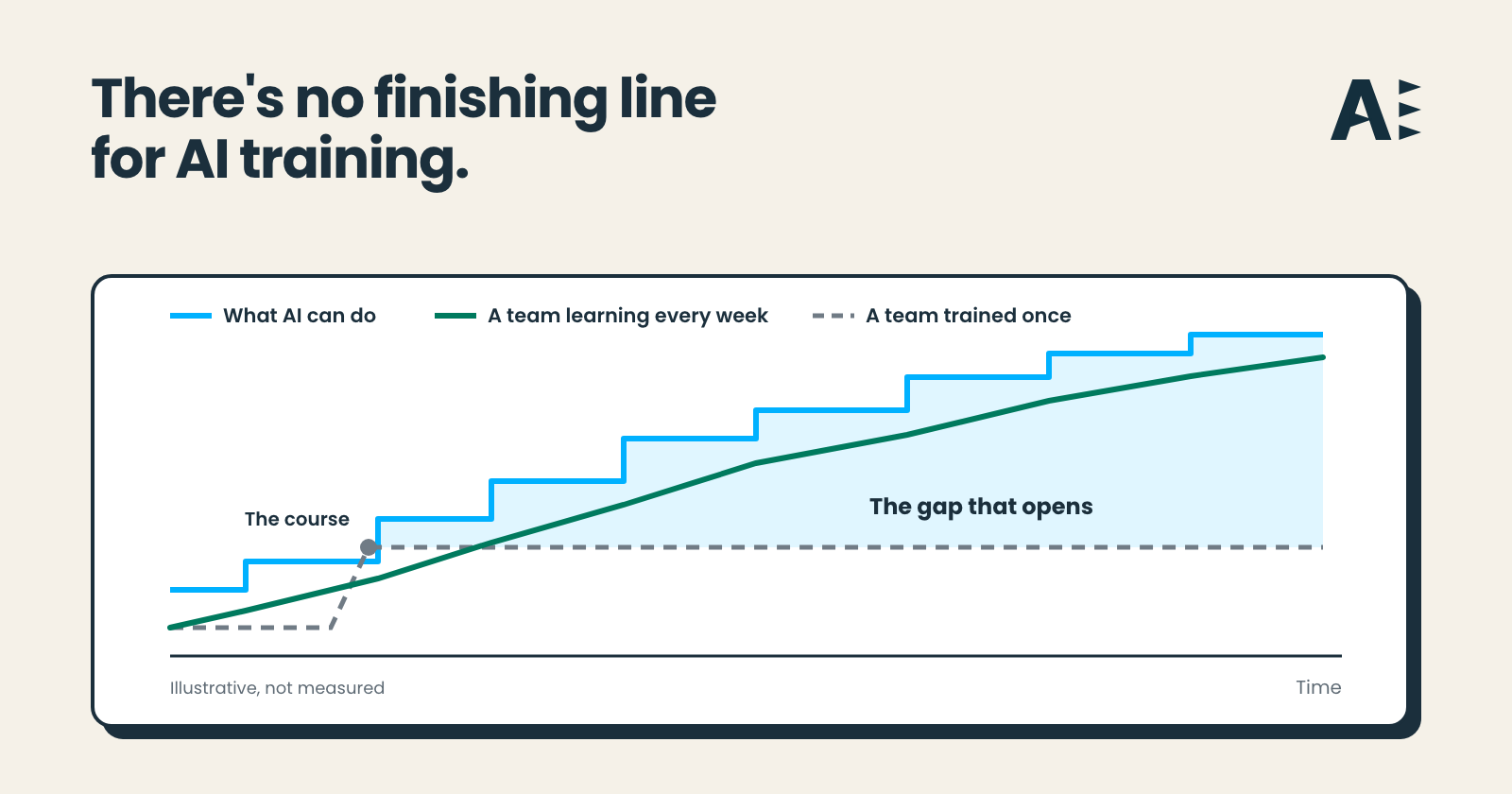
Most organisations still buy AI training the way they buy most training. Pick a provider, book the sessions, get everyone through, tick it off. It's a project, with a start, an end and a report.
The trouble is that AI doesn't have an end date. What your people learned six months ago is already out of date. Not the thinking behind it, which mostly holds. The tools, what they can do, and the best way to get value from them.
01What goes out of date
We once ran a workshop teaching a particular AI video tool. On the Monday morning, the company behind it switched the whole thing off. Four people turned up to learn a tool that no longer existed. We got through it, but it taught me something I've stuck to since: teach techniques, not tools.
Even techniques move, though. Every few weeks there's a new model. Features appear inside tools your organisation already pays for, often without anyone telling you. Things that needed a specialist last year are now a button. Things we told people to avoid, because the tools did them badly, are now worth switching on.
And whatever you see now is the least capable AI is ever going to be. I say that every time, and every time it's true.
So a course can be excellent on the day and still leave people with a picture that slowly stops matching what's in front of them. Nobody does anything wrong. The ground just moves.
02The project mindset
The project approach gives you a moment of confidence. Everyone's been trained. The box is ticked. Then the picture ages quietly, and it's hard to see from the inside, because the people who were trained still feel trained.
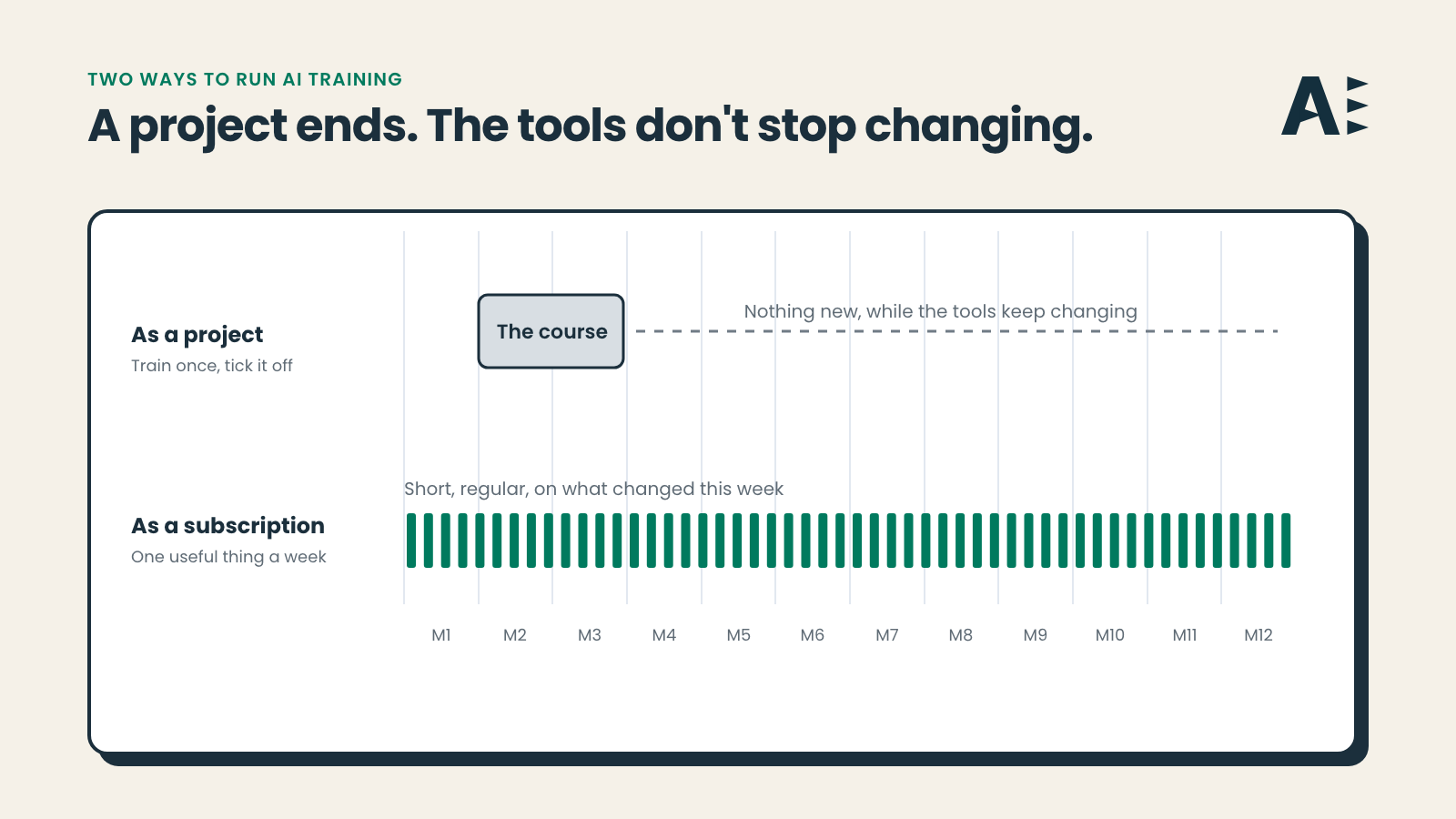
The alternative is to treat AI capability like any other service the business depends on. You wouldn't do your security training once and call it done, or update your software once and stop. AI belongs in that category now: something you keep current, at a pace that suits you.
03What a subscription looks like
When I say subscription, I mean a rhythm more than a contract. In practice it looks like this:
- Short and regular, not long and rare. One useful thing a week beats a two-day course a year. Five minutes on a Tuesday is easier to protect than a day out of the diary.
- Focused on what changed. Most weeks, most of what's new in AI won't matter to you. Someone should be filtering it, so your people hear about the few things that do.
- Applied to real work. The learning sticks when people try it on their own tasks the same week.
- Honest about what to skip. Part of keeping current is knowing what to ignore, or what to wait three months for.
The big moments still have a place. A good first session, or a day where a team works through its own problems together, is often where things really get going. But it's the front door, not the whole house.
04Questions to ask about your own plan
- When does our AI training end? If there's a date, what happens after it?
- Who tells our people when something important changes?
- How would we know if what they learned had gone out of date?
- Is there a regular, small slot for learning, or only big events?
If the answers are "it ends in March", "nobody", "we wouldn't" and "only big events", that's common, and it's a straightforward thing to change. Training is also only one of three things worth planning together.
05How we do it
This is why we built AI Accelerator around a subscription. Every week we watch what changes, test it on our own work, and turn what matters into short, practical cards your people can use the same day. When things change, the cards change with them.
If you're planning next year's AI upskilling and want to talk it through, talk to us. We're as happy to tell you what to leave out as what to put in.