AI in the event plan, not just the fan app.
Event teams rebuild the same plans, briefings and reports every edition, then the knowledge leaves with the crew. We help leaders agree where AI fits, and help teams learn it on their own documents, with safety and legal on board.
Already running an AI programme? See how we fit in ↓︎
Where this comes from
- Technology for global tournamentsOur founder has delivered technology for global sporting events, including World Cups and an Olympic Games
- Venue planning for a global tournamentCAD standards, venue technical guides and location data across its venues
- 200+ senior leadersDirectors, VPs and executives, in live sessions
- 40+ live sessionsLeadership briefings, workshops and webinars
- Cyber Essentials PlusCertified, and registered with the ICO
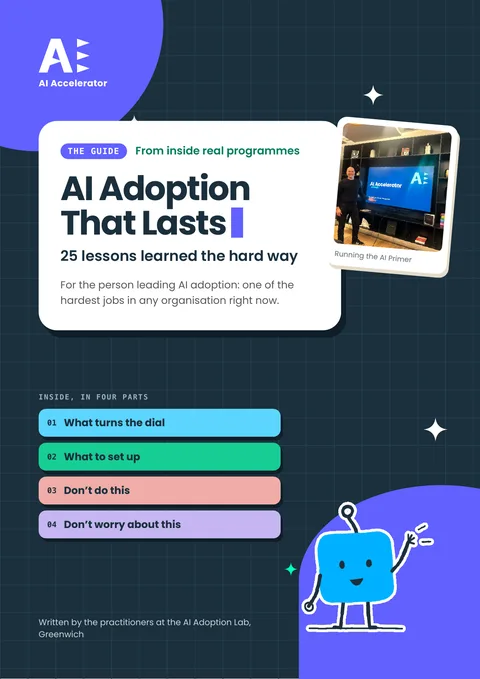 Free guideAI Adoption That Lasts: 25 lessons from running AI adoption programmes.Read it now →︎
Almost everyone has tried AI. Very few have built it in.
Use is wide and shallow across events. These are sector figures, each with its source. None of them describes our clients.
AI across exhibition companies
91%
use AI in their business
4%
have built their own
Source: UFI Global Barometer, July 2026, 466 companies. Industry body.
UK events industry
the value of the UK events industry, where most of the hours go into plans and paperwork
Source: UKEVENTS, UK Events Report 2025.
What holds event teams back
6 in 10
event professionals name a lack of knowledge as the barrier to using AI
Vendor researchSource: EventsAir, October 2026, 380 respondents.
Sector figures from the sources shown. The vendor figure is labelled as such.
What we see in major events.
The AI conversation in events is mostly about fans. The hours, and the blockers, sit behind the scenes.
The knowledge leaves after every edition. Plans get rewritten from scratch and debriefs go unread.
Thousands of temporary staff, contractors and volunteers need the right briefing on the right day.
Information doesn't flow between partners. The big reviews of crowd incidents keep finding the same thing.
The AI headlines are fan-facing. The operations side, where most of the hours go, is mostly untouched.
Your programme first. Then where we fit.
Your AI programme has its own goals and its own shape. So we start by understanding it: what it needs to achieve, how it's structured and where you want to accelerate. Then we add only what helps.
Most event organisations already have a digital or AI lead. We fit around their plan.
Leadership sessions
Your senior team uses AI on its own work and sees what other leaders are trying.
Practitioner-led training
Event delivery, safety and venue teams learn on their own kind of work.
Practitioner webinars
Regular live sessions open to the whole business: we show how, then everyone has a go.
Ongoing platform access
Short lessons, events use cases and reusable skills between sessions.
40 ways event organisations can put AI to work.
From the bid to the legacy report. The same cards our platform uses: deal through them, or pick a team, and open one to see what AI does and what stays with your people.
Why now: skills
Agents used to be projects for IT. Skills put the same power in everyone's hands. A skill packages how your best people do a task, the steps, the checks and the house style, so anyone in the team can run it with AI and get the same quality. Many of these use cases start life as a skill.
The chief executive and board decide whether to bid.
Legal and the director interpret what each clause requires.
The bid director owns every claim, commitment and the final voice.
The director decides what to escalate and what the board sees.
Plan owners decide what fits this edition and sign it off.
You choose who to chase, how hard, and what to let go.
Each document owner approves or rejects every edit.
The operations lead decides which figure is right.
The safety lead decides which version is right and signs off.
A competent person checks each flag on the drawing and on site.
The named responsible person judges if the evidence is enough.
The safety lead resolves each disagreement with the partner.
A named control-room lead approves every message before it goes.
The safety officer decides what each exception means and who acts.
The venue manager reviews each flag and accepts or rejects it.
The operations manager decides what to chase and what to move.
Operations proof every sign and confirm positions on site walks.
Staff act on the source document, not on the summary alone.
A coordinator clears the queue and owns each record.
The safety lead approves it; supervisors deliver it.
The workforce manager decides each fix and who is moved.
The safety lead sets the scenarios and signs off the procedure.
Coordinators answer anything it cannot and review its answers.
Leads decide which lessons become changes to the plan.
The accreditation lead and security approve every access right.
The logistics lead decides who is cleared to arrive on site.
The logistics lead decides which request gives way.
The accreditation team approves the template and any unusual note.
The partnerships manager confirms what was agreed and fixes it.
Owners deliver; the partnerships manager handles any shortfall.
The partnerships manager confirms each item proves the obligation.
The partnerships manager sets the price and owns the relationship.
The fan experience lead checks every rule survives the rewrite.
The ticketing lead agrees fixes with the platform provider.
The comms lead decides the right version and fixes every channel.
The comms lead approves every update before it goes live.
Leads decide what goes in and what the next team should change.
The sustainability lead decides what to query and what to accept.
The sustainability lead checks the log before any figure is used.
The sustainability lead decides what can be said publicly.

Built from your plan, run on the day, better every event.
Four working demos on an invented match day. Open any of them and click through. In every one, AI reads, drafts and flags, and your people decide.
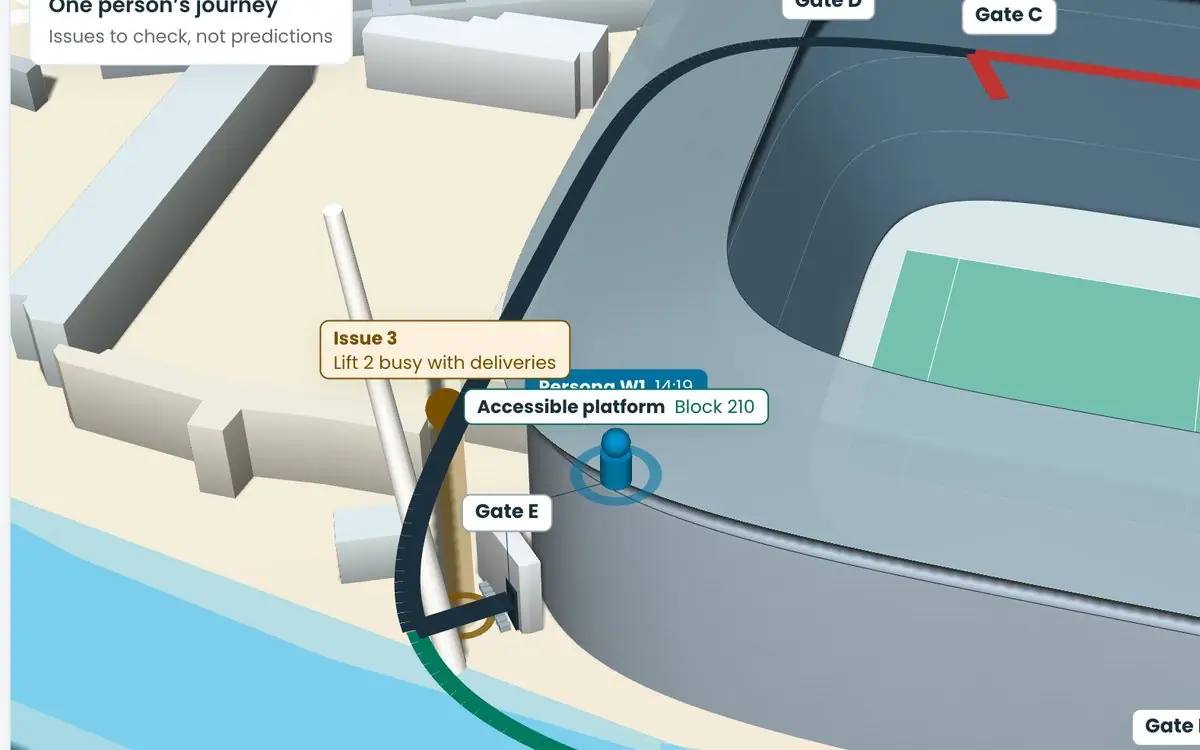 1 · Before the day
The Rehearsed Event
Rehearse the plan weeks before match day. AI runs a command tabletop and walks one attendee's journey, so the gaps in the plan show up while there is still time to fix them.
Open the demo →︎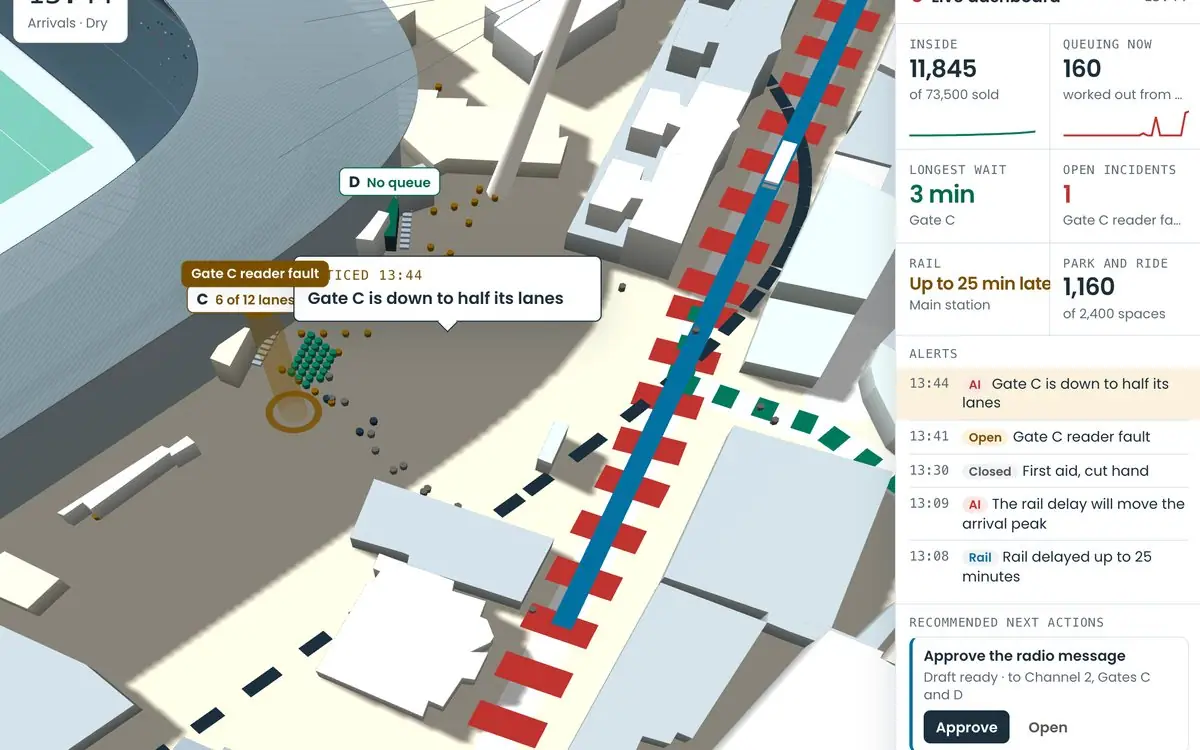 2 · On the day
The AI control room
Run the day from the plan you already wrote. The live picture, alerts and recommended next actions in one place, and your team approves every message before it goes.
Open the demo →︎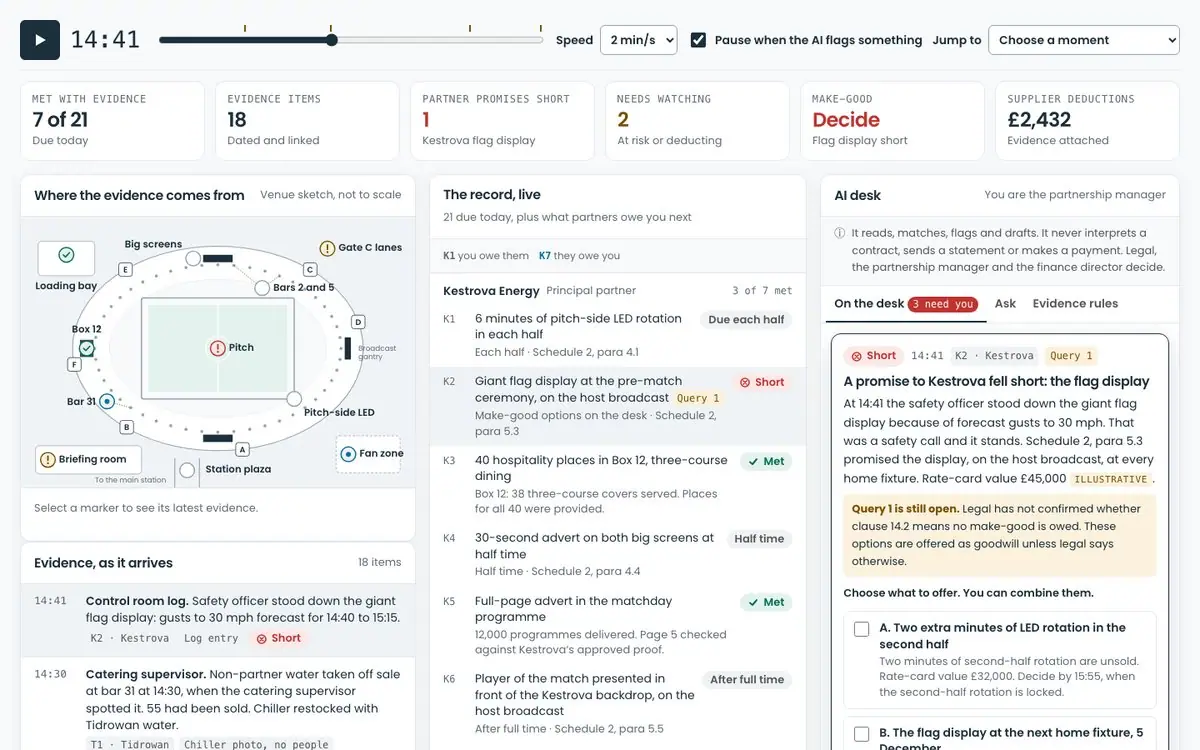 3 · After the whistle
Every Promise, Proven
Settle partner and supplier contracts on evidence. AI matches each promise to dated proof as the day runs, then drafts the proof pack and the settlement for people to approve.
Open the demo →︎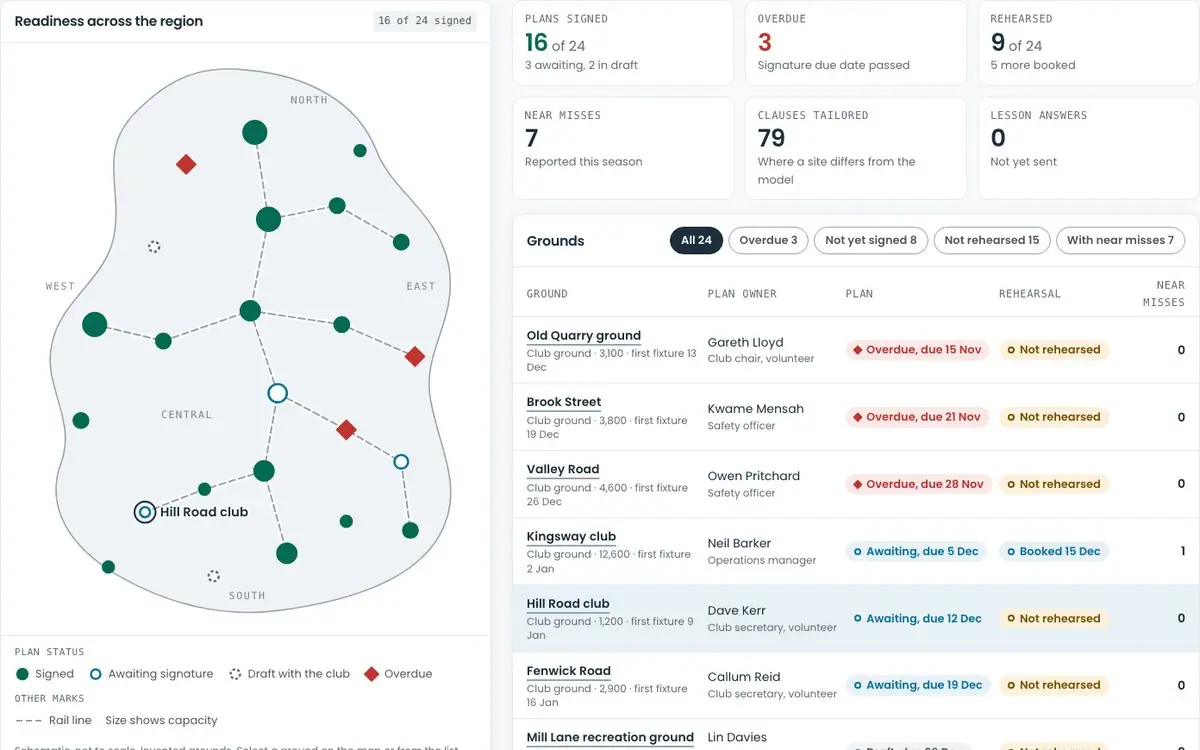 4 · Across the season
One Plan, a Thousand Events
Give every ground the same model plan, tailored to its own site. See which plans are signed and rehearsed, and carry each near miss into every next plan.
Open the demo →︎
Illustrative demos: the events, organisations, people and figures are invented, and none is based on a real event, venue operator or client. Best opened on a laptop.
The questions your safety and legal teams ask first.
Martyn's Law
AI can draft and check the written plan and keep the evidence in order. The responsible person signs off and stays accountable. The main duties have no start date yet.
Biometrics at the gate
The EU AI Act already bans some uses, with high-risk duties from 2 December 2027, and the ICO expects a data protection impact assessment (DPIA) before any biometric recognition. We don't work on facial recognition.
Volunteer and accreditation data
We help you write simple rules by data type: what can go into which tool, redact before you paste, approved tools only.
What you say about AI
Public and sponsor claims say "documented use", never "proven impact". We help comms teams keep claims about AI honest.
We work this through with your safety, compliance and legal teams. It is not legal advice.
AI changes every month. Your people's knowledge should too.
A one-off course goes stale. Our platform keeps a steady supply of short lessons, use cases and activities coming to your teams, updated as the tools change. Signal, our newsletter, tells your leaders what changed and what it means for them.
- Minutes, not days. Each card is a short lesson, a use case or an activity people can do in their working week.
- Your own use cases. The use cases your teams choose sit beside ours, on the same cards.
- Signal. What changed in AI, and what it means for event organisations, in plain English.
- Measurement built in. It is why we built the platform. You see who is using AI, which use cases stick and how confidence changes from people's first check-in to their last, so you can show the board what changed.
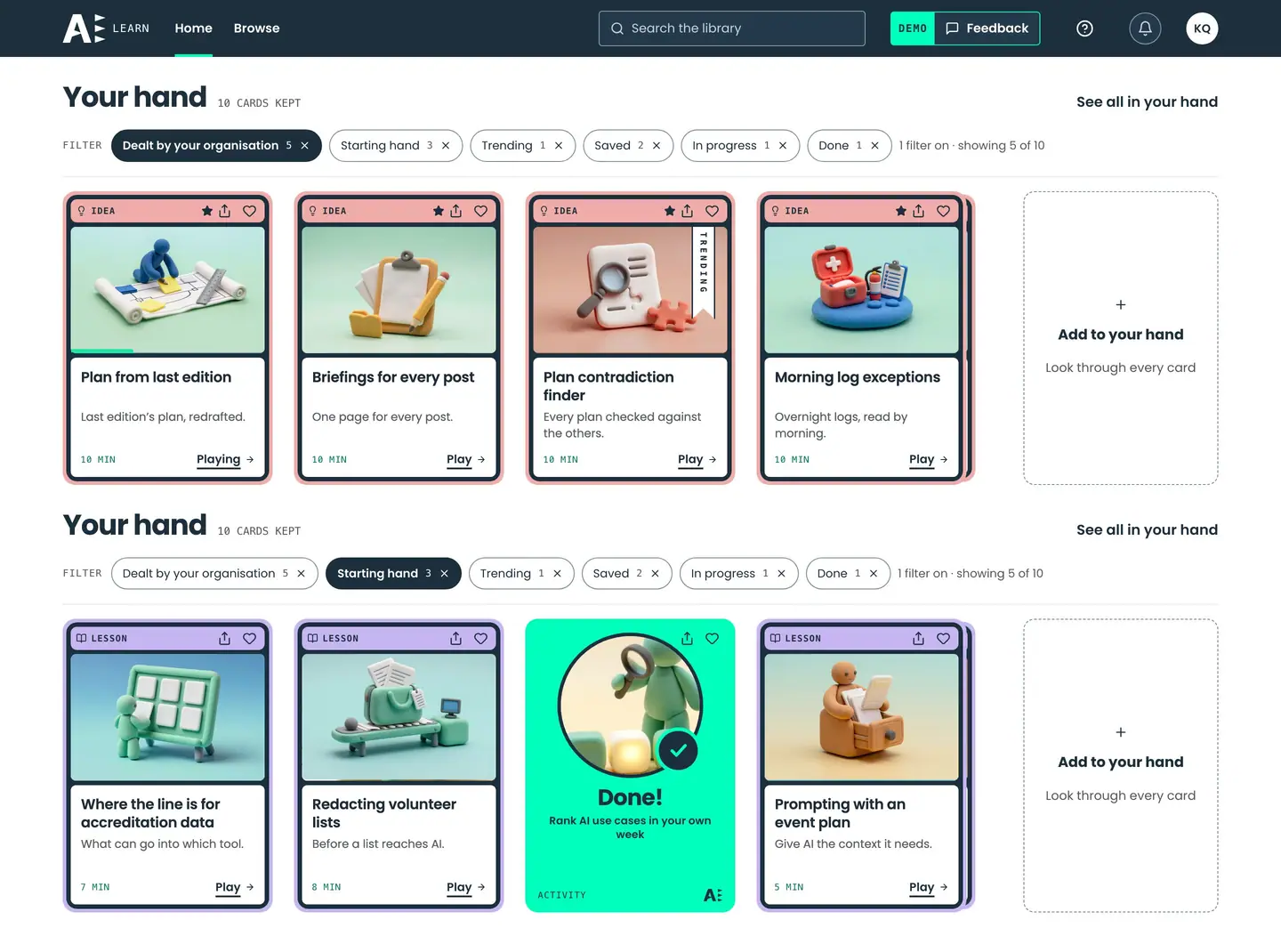
- Dealt by your organisation. Your AI lead deals events use cases to each team.
- Trending. Teams see what colleagues elsewhere in the business are trying.
- Your own rules. Lessons written to your policy, such as where the line is for accreditation data.
- Progress you can see. Done cards show who has picked up which habit.
- Ten minutes a card. Short enough to fit inside the working week.
Working with us, step by step.
Start wherever suits you. Each step is useful on its own, and you decide whether to take the next one.
Step 1 · 30 minutes · Free
Compare notes with us
We share what we are seeing in AI across events and ask about your teams. You leave with three use cases worth trying first.
You do: pick a time. We do: send two short questions beforehand.
Book a time →︎Step 2 · Half a day
Brief your leadership team
Your senior team uses AI on its own work, agrees where the line is and picks the first use cases. Online, at your office or at our Lab in Greenwich.
You get: a short written plan your board can read.
About leadership sessions →︎Step 3 · From £1,500 a session
Train your teams
Practitioner-led sessions for event delivery, safety and venue teams, built around their own kind of work.
Price per online session, excluding VAT.
How sessions work →︎Step 4 · Ongoing
Keep everyone ahead
Our platform and Signal keep the learning going after the sessions end, so the habit sticks and nobody falls behind.
You get: new cards as AI changes, and measures you can take to the board: who is using AI, what stuck, what changed.
See the platform →︎
Want to see us first? Come to a free Live from the Lab session →︎ Or download the AI adoption guide, free.
See also: AI adoption for insurers →︎
AI Adoption That Lasts: 25 lessons learned the hard way.
What we have learned running AI adoption programmes inside real organisations: what turns the dial, what to set up, what to skip. Written for the person leading AI adoption.
Questions event organisers ask us.
We already have a digital team. Where do you fit?
Alongside them. Your digital or AI lead owns the programme. We add leadership sessions, hands-on training on your own documents and the platform between sessions, only where they help.
Our workforce is mostly temporary. Is training worth it?
Train the permanent core, the people who write the plans. They then use AI to build the briefings for the temporary workforce, so each post gets the right briefing on the right day.
Can AI help with Martyn's Law?
It can help your team keep the written plan current and the evidence in order. It doesn't make you compliant, and the responsible person stays accountable. The main duties have no start date yet.
Will you put our crowd or attendee data into AI?
No. We work on your plans and documents, with clear rules on what can go into which tool. We don't do crowd detection or facial recognition, and every safety decision stays with a person.
We use one AI tool already. Do your use cases depend on another?
No. The use cases describe the work, not a product. We teach them in the tools your organisation already has approved.
Let's compare notes.
Thirty minutes on what we are seeing in AI across events, and where your teams could start.