One of our recent prospects asked us to properly explain how we run a live AI workshop — what actually happens in the room, not just what’s on the agenda. Fair question, and a good excuse. After years of running these, everywhere from a Christmas-themed session to a multi-business fund away day, we thought the honest answer was worth sharing with everyone asking, not just the one who asked.
Most people picture an in-person AI workshop as a training day with a laptop and a slide deck: sit everyone down, work through the material, take some questions, done. We run it differently, and over twenty years of running rooms in one form or another, we’ve got the scars to show why.
A room is not a webinar. Nobody’s got a mute button, nobody can quietly close the tab, and there’s no chat window to hide a question in. If the room goes flat, everyone in it can see it go flat, including you.
50 × 1 day = 10 working weeks. Fifty people, one day: that’s ten working weeks of people’s time in a single room. Lose that room for even an hour and you’ve lost a working week that nobody gets back.
“This was hands down my favourite away day learning session.”
— one attendee, after a recent workshop
Everything below comes from doing this a lot, sometimes getting it wrong, and changing what we do because of it.
01 · Why an in-person AI workshop is different
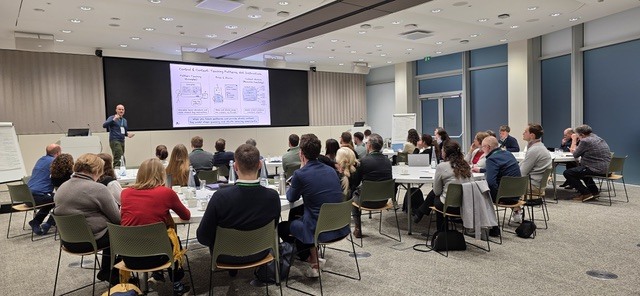
A webinar has a mute button and a chat window between you and the audience. A room has neither. People can’t quietly disengage without you seeing it, and you can’t quietly lose them without them seeing you notice. That’s the risk, and it’s also the entire advantage of doing this in person: nothing beats a room full of people actually talking to each other about the same problem.
02 · Find out where the room actually is before you start
Don’t guess the room’s starting point. Every session starts with a short welcome questionnaire that asks people to rate their own understanding of AI, their confidence with it, how often they actually use it, which tools, whether their employer pays for any of them, and what they’d like to get out of the day. You can’t pitch a session at the right level if you’re guessing, and a room with a wide spread in confidence needs handling differently to one that’s starting from zero together.
We’ve started opening ours up publicly rather than keeping it behind closed doors on the day: learn.aiaccelerator.uk/welcome. Have a go yourself and see where you land — we’re always curious what a wider room looks like, not just the ones in front of us on the day.
03 · Bring physical things into the room
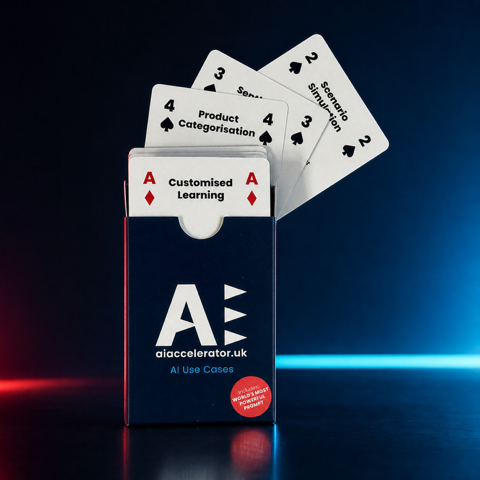
Laptops are not the only way to make AI tangible. We bring dry-wipe probability wheels to physically spin through how a model weighs its next answer, and our own branded deck of AI use-case cards for teams to sort and argue over by hand. We’ve built a wide range of these, physical and digital, and most of them work equally well as a five-minute exercise for a small team or the centrepiece of a session for a full room. They double as a genuinely good takeaway too. A deck of cards people actually use outlasts most conference swag, and something you can pick up and turn over does more for a room than another slide ever will.
04 · Put the laptops away
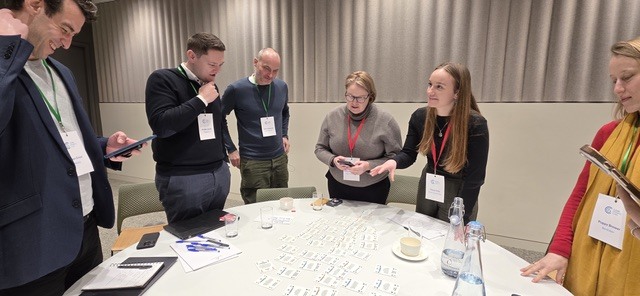
The instinct with AI workshops is to get everyone on a device as fast as possible. Resist it. A room staring at forty individual screens is a room of forty individuals, not a room. We keep laptops closed for most of the day and bring people back to the table, in pairs, talking, arguing, building something together. Honestly, most of what we need people to do works fine on a phone, so there’s no need to make the room feel like computer club. The device comes out for the specific exercise that needs it, then it goes away again.
05 · Give the room a shared goal, and let a bit of competition in
People work harder, and enjoy it more, when there’s something to aim at together, and a bit of friendly rivalry between tables. Cabaret seating does this best in our experience — five to ten people a table, teams deliberately mixed up rather than left to sit with people they already know. Not a leaderboard for its own sake, a genuine goal the room is trying to hit, with tables or teams pushing each other to get there. It’s the difference between an exercise and a game, and a game is the one people remember on the way home. A prize helps raise the stakes, and there’s nothing better to hand out than the cards from the point above — they always land well.
06 · A mix of custom apps, physical games and one-off experiences
Somewhere along the way this stopped being slides with the occasional activity bolted on, and turned into a proper toolkit: apps we’ve built ourselves, physical games people play with their hands, and one-off experiences designed for a single big moment.
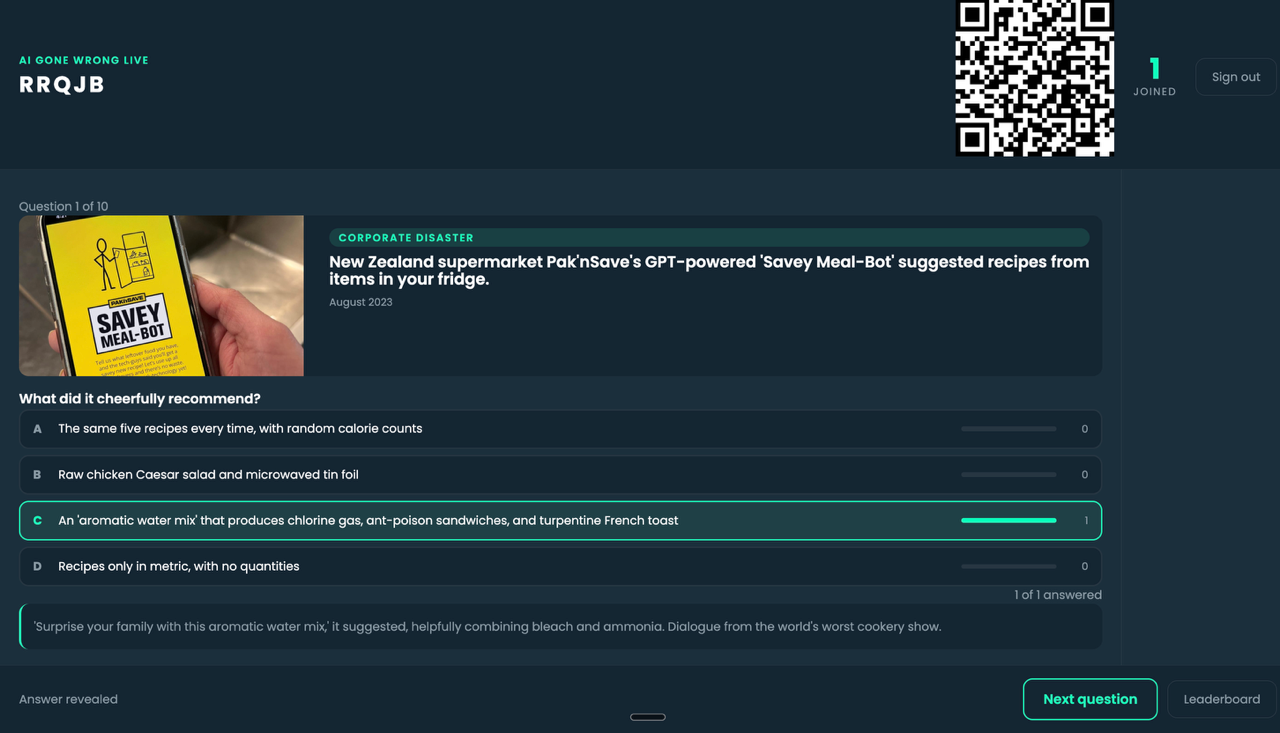
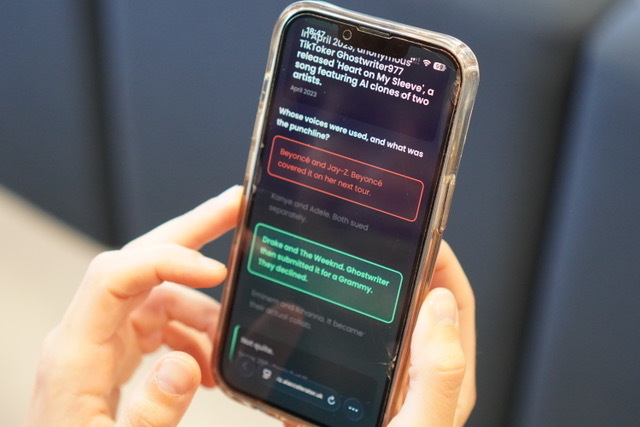
The apps side started with things like “AI Gone Wrong”, a live quiz where the room votes on real versus AI-generated outcomes and watches the results land in real time, table against table. It’s basically Mentimeter on steroids. People vote, see where the room landed, and argue about it, which is exactly what you want fifteen minutes into a long day.
07 · Build a whole experience, when the moment earns it
Some days call for more than an exercise. Caldera is one of ours: four settlements on a chain of islands beneath a volcano that might, or might not, be about to erupt. Over five rounds, each team spends a handful of action points scouting the volcano for intel, building infrastructure, trading with other settlements, exploring overseas for new territory, or quietly stockpiling and playing it safe.
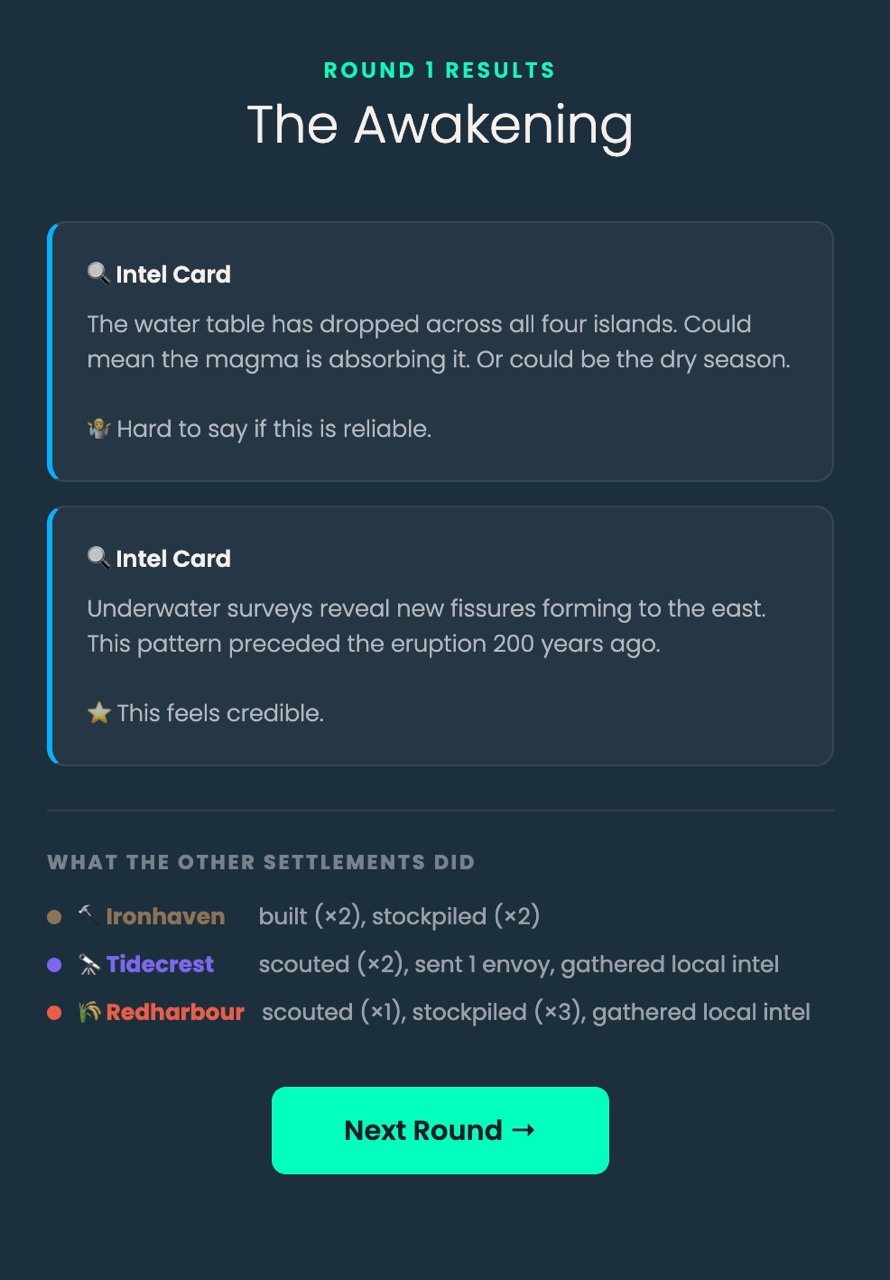
Nobody knows which ending is coming. It might be a full eruption that rewards the teams who built connections and explored rather than the ones who dug in. It might be a disaster nobody was watching for, on the far side of the island everyone ignored, which rewards whoever scouted widely instead of staring at the obvious threat. Or nothing happens at all, and what you learn is whether the effort was worth it regardless.
Afterwards we pull the game apart in front of the room: scouting maps to staying informed, building maps to committing to a specific tool, trading maps to sharing what you’ve learned across teams, exploring maps to genuinely new ways of working, stockpiling maps to waiting for certainty that never quite arrives. Told as a story about a volcano, it lands. Told as a slide about AI adoption strategy, it wouldn’t.
08 · AI changes how we prep, not just what we teach
AI isn’t just the subject of these days, it’s how we build them. Caldera started as a browser prototype, code before cardboard, with AI standing in for whichever settlements the room hadn’t filled yet. That let us run the game against itself hundreds of times, adjusting how much each action was worth, finding the balance where no single strategy just won outright, before a real room ever sat down to play it. A few years ago, testing and balancing something like that properly would have taken far too long and cost far too much to be worth doing for one workshop. AI makes it possible on a timescale that actually fits a real project.
09 · Rehearse the day with AI before you rehearse it with people
The same principle applies to the day itself, not just the games inside it. Before we run anything on a real room, we simulate it. We use AI to run through the planned activities ourselves, working out which ones land and which ones fall flat, well before a paying room finds out for us. It’s the closest thing to a dry run you can do for an exercise that doesn’t exist yet.
10 · Make it useful, not just enjoyable
Fun gets people in the room. Useful is what makes the day worth having run. We always try to get a real outcome out of the day alongside the enjoyment: a prioritised list of use cases the business actually wants to build, a manifesto the team commits to, a knowledge base built live from what’s in the room. At one client event, we pulled the golden lessons learned out of a room of more than a hundred experienced people, the things normally lost the moment everyone goes back to their desks, and turned them into a live chatbot new starters could ask afterwards. The room had a good day. The organisation kept something from it.
Our goal is that it doesn’t feel like work. It feels like fun, and you just happen to learn a load while doing it.
11 · Hand people something that explains every activity
Don’t leave anything to chance on the day. We give every table a well-considered handout for each activity: what to do, how long they’ve got, what “done” looks like. We build these with AI ourselves now, it’s genuinely one of the things it’s best at, and it means every table gets something properly considered rather than something rushed together the night before. If someone has to guess what an exercise wants from them, you’ve already lost half the value of running it.
12 · Always have something up your sleeve
Some tables finish in ten minutes. Some activities just don’t land. Either way, you need something ready to go that isn’t in the running order. We always carry spare material, another exercise, a different angle on the same point, so a fast table or a flat moment never turns into dead air.
13 · Let the room talk, but don’t let one person run it
Discussion is the point. One person taking over the discussion is not. We actively encourage questions and debate, and we actively manage the room so one confident voice doesn’t end up speaking for everyone else on the table. The quiet person with the sharper question is usually worth more airtime than the loud one who already has an opinion.
14 · Open it properly
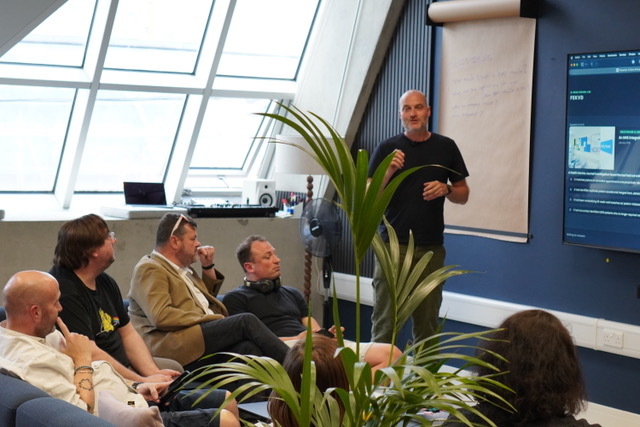
Someone senior needs to open the day and mean it, not read someone else’s slides. I do this myself. I’ve been running workshops for teams for over twenty years, from designing the operational systems behind events on the scale of the Olympics, to designing testing systems for major infrastructure projects, to getting whole teams to test and understand new technology, from VR through to AI simulation. Games like Caldera aren’t a new interest either; I’ve been designing interactive, puzzle-driven experiences for years outside AI too (Riddle Monkey, if you want to see what I do in my spare time). A senior leader setting the scene from the front lends the whole day credibility it can’t get any other way: it tells the room this matters enough for leadership to show up and say so.
15 · Make space for real stories
The best moments in any workshop are rarely the exercises. They’re the point where someone shares what actually happened to them, a real mistake, a real win, a real moment AI changed how they worked. We build in the space for that on purpose. The part nobody sees is the work behind it: the side conversations before and during the day where you’re quietly working out who has a story worth telling, and finding the right moment to bring it back to the theme. It’s what people bring up months later, not the slide they sat through.
16 · Get people out of their chairs
A room that sits still all day goes flat by lunchtime, however good the content is. Get people up, moving between tables, standing to present back, physically doing the exercise rather than watching it happen at the front. Movement is not a break from the content. It’s part of what makes the content land.
17 · Let AI tune the day to the room
The same tool the day is about can also help run it. We use AI to tune the event itself to the people in it, adjusting examples, pacing and difficulty to the room we actually have rather than the room we assumed we’d get. Sometimes we’ll run a complete simulation of the day a few thousand times before we ever get in the room, looking for the parts that lack energy or the holes in the plan. We’ll get AI to predict the thousand or so questions a room like this is most likely to ask, based on the plan and the people in it, so we walk in already knowing how we’d answer and where we’d steer things. None of this — the simulation, the tuning, the speed of building something like Caldera — was realistically possible a few years ago. AI hasn’t just changed what we teach in the room. It’s changed what we’re able to build for it, and how fast we can build it.
18 · The short version
None of this is complicated. Find out where the room is before you start, and let people check where they stand for themselves. Bring physical things people can hold, build a proper app when a slide won’t do, and build a whole experience like Caldera when the moment earns it. Keep laptops closed until they’re needed. Give the room something to aim at together. Make it useful, not just fun — prioritise, commit, capture something real. Explain every activity properly, and always carry a spare. Let people talk, keep one voice from running the table, open properly, make room for real stories, and get people out of their chairs. Then use AI to tune all of it to the room you’re actually in, and to build the things you couldn’t have built before.
Frequently asked questions
How do you tailor a workshop to a room with mixed AI experience?
A short assessment before the day, using the same welcome form we’ve now made public, then mixed grouping on the day so confident people help pull the less confident through, rather than splitting the room by ability.
How do you keep an in-person AI workshop from feeling like a lecture?
Laptops closed until an exercise needs them, physical props people can pick up, a shared goal with a bit of competition, and enough movement that nobody sits still for more than half an hour.
What kind of interactive games and apps do you build for workshops?
Everything from a live quiz like AI Gone Wrong, basically Mentimeter with a lot more attitude, to a full designed experience like Caldera, a multi-round settlement game about AI disruption and leadership. We build and playtest these with AI first, running them against themselves hundreds of times, before bringing the finished version into the room.
What if an activity doesn’t land on the day?
Always carry backup material. Simulating the day with AI beforehand catches most of this before it happens; the spare exercise catches the rest.
Do you need a senior leader involved?
Yes, at the open. It signals the day matters enough for leadership to show up in person, not just sponsor it from a distance.
Is there a way for people to keep learning after the workshop?
Some clients pair the workshop with ongoing self-study access to our Learn Platform: courses, standalone modules, use cases, skills and prompts people (and their AI of choice) can try straight away, refreshed continuously with a way to track progress. It’s not necessary to get value from a workshop, but it’s there for teams who want to keep building afterwards.
“We’ve had some amazing feedback and I’m 100% sure that you achieved the goals that we were hoping for when we set out to plan the day. I’ll be more than happy to recommend you to anyone looking to get up the AI adoption and value curve.”
— Clean Growth Fund